
Sudden Fear
When Fear Kills the Narrative
He felt a sudden fear. The implications of what had just been said were immediately clear to him, and he understood that his position was now far more dangerous than he had previously believed.
He considered the situation carefully. There was little he could do to alter the course of events, and the knowledge of this only increased his fear as he realized how limited his options truly were.
Where, in these two paragraphs, does the fear actually occur?
Is it in the moment itself — or only in the explanation that follows it?
The fear does not unfold. It is delivered.
It arrives as an information dump, followed by clarification, then confirmation. The language pauses to assess, to summarize, to explain what the reader is meant to understand before anything has time to press forward.
The moment reads less like an experience and more like a set of instructions: this is the danger, this is why it matters, this is how the character responds.
Nothing is left unresolved. And because nothing is left unresolved, nothing lingers.
It creates distance between the reader and the protagonist.
When fear is delivered as explanation, the reader is positioned outside the moment. They understand the situation, but they do not inhabit it. The scene becomes something to be observed rather than endured.
Over time, this changes how the story is read. Scenes stop accumulating weight. Danger feels theoretical. The reader learns to wait for summaries instead of watching for consequences.
The story continues, but as an accounting of events rather than something lived.
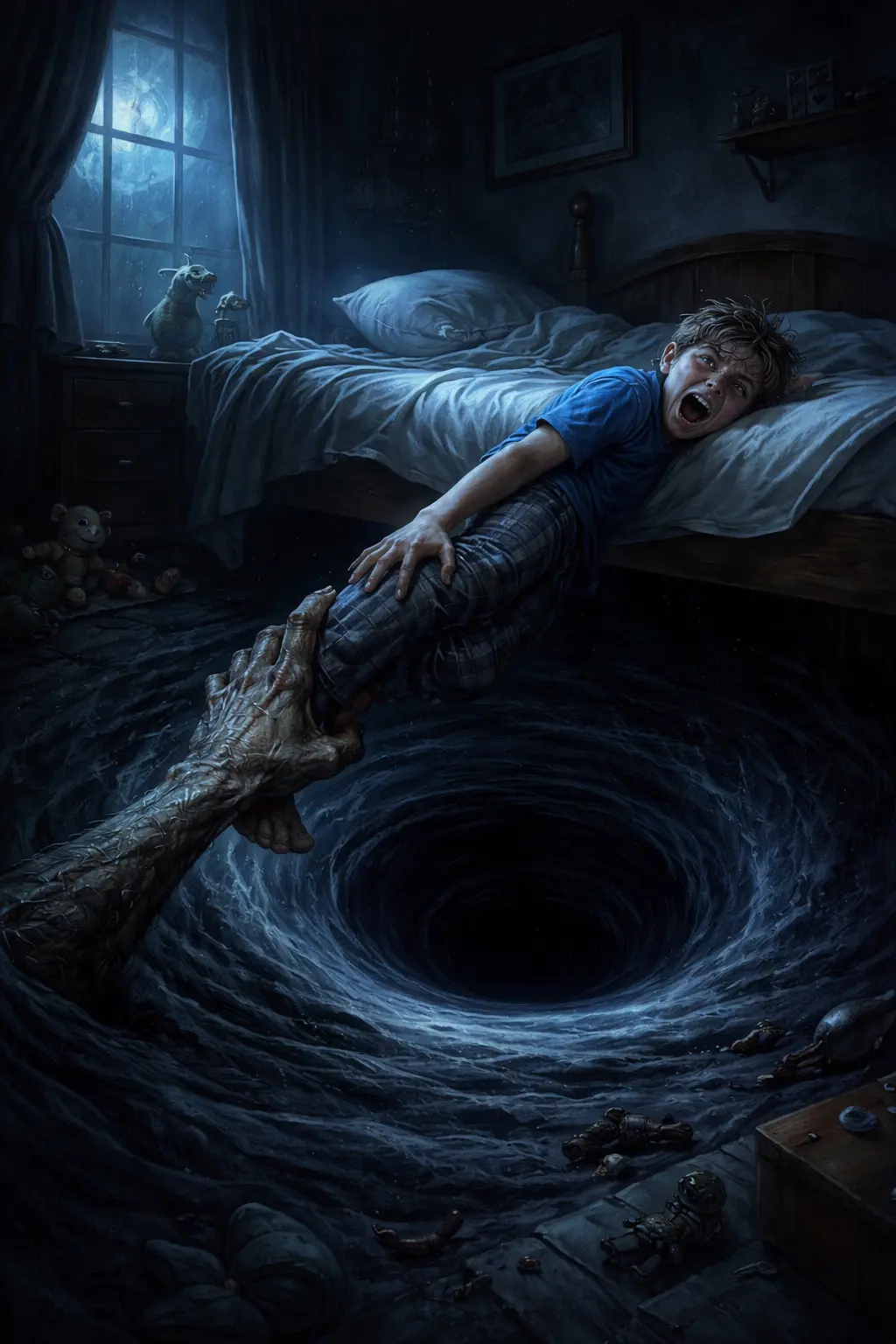
The Same Moment, Without Naming the Fear
I lay still, listening to the heater tick as it warmed. The room smelled of coal. I took a few breaths and turned onto my side, but the cold pressed in from the floor and the walls.
“Hey.”
Hands caught me and ripped me out of the bed. My shoulder struck the floor and the breath went out of me. My head hit the cold stone. The floor was solid.
Then the floor gave way.
I was falling and falling and flailing and panicking and falling. Then I sensed a presence. Something followed me.
When I hit the ground, I rolled and ran. Floors became ceilings, walls shifted, corridors stretched and folded. Doors became walls, and I ran because something terrible was behind me.
There, the library. My hidden corner. Quiet. Be quiet. Be still. Be invisible.
I saw it.
Something above me, wide and wrong, watching without moving.
I hardly breathed, just enough to whisper.
“Mother.”
If this moment stayed with you, the story continues.
Golden Eyed Wolf is the beginning of the Mortal Immortals series.
Read Book One on Amazon